
How to Calculate Fire Extinguisher Travel Distance for OSHA Compliance
Updated: May 4
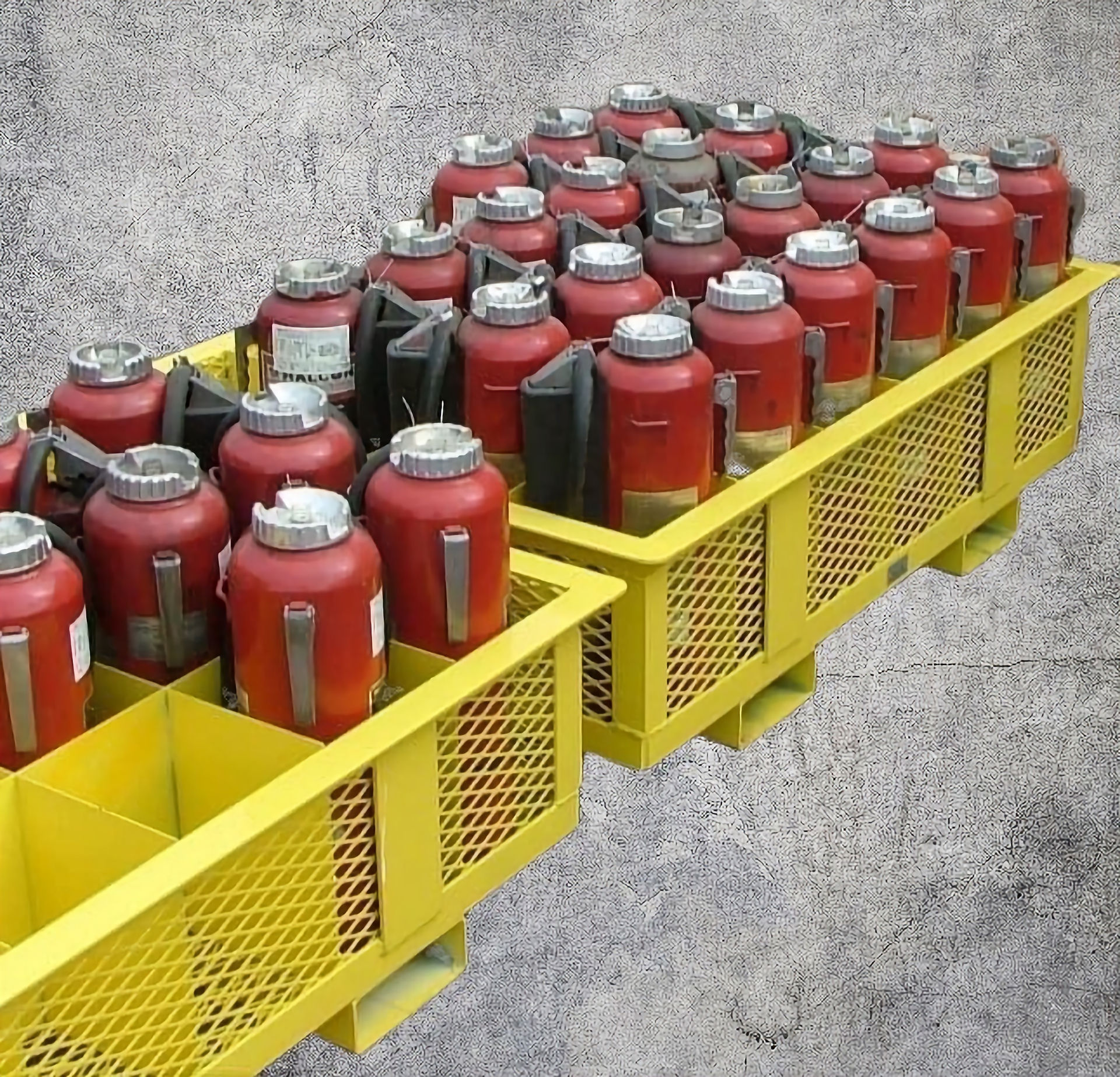
Floor-standing storage racks consolidate extinguisher coverage at high-traffic intersections. 
12-place racks at aisle end caps cover up to 75 feet in either direction — one station, two aisles.
OSHA 29 CFR 1910.157(d) requires that employees travel no more than 75 feet to reach a fire extinguisher for Class A (ordinary combustible) hazards, and no more than 50 feet for Class B (flammable liquid) hazards. These are actual walking distances — not straight-line measurements on a blueprint — which means your facility layout, racking systems, equipment placement, and aisle configurations all affect whether you pass or fail an inspection. Getting the calculation wrong is one of the most common fire safety violations in warehouses and manufacturing plants, and penalties for a serious violation reached $16,131 per instance in 2026.
This guide walks through how to measure travel distance correctly, plan extinguisher placement for warehouses and industrial facilities, and use rack-based storage to consolidate extinguishers without breaking compliance.
What OSHA Actually Requires
The travel distance rule comes from two sections of the standard:
1910.157(d)(2) — Class A hazards: extinguishers must be distributed so that travel distance does not exceed 75 feet from any point in the workplace.
1910.157(d)(4) — Class B hazards: travel distance must not exceed 50 feet.
1910.157(d)(3) — Class C hazards (energized electrical): OSHA does not set a specific travel distance. Instead, you must distribute extinguishers based on the pattern required for the underlying Class A or B hazard, then provide a Class C-rated unit within that distance.
For a complete OSHA 1910.157 overview, see our /osha-fire-extinguisher-compliance.
The Critical Distinction: Walking Distance vs. Straight Line
OSHA measures travel distance as the actual path an employee would walk to reach the nearest appropriate extinguisher — not a radius drawn on a floor plan. In a warehouse with 40-foot pallet racking aisles, a straight-line distance of 60 feet might translate to a walking distance of 120 feet or more if the employee has to go around racking to reach the extinguisher.
This distinction trips up facility managers more than any other part of the standard. During inspections, OSHA compliance officers will physically walk the path from various work locations to the nearest extinguisher and measure it.
How to Calculate Travel Distance in Your Facility
Step 1: Identify Your Hazard Classes
Walk the facility and map every area by its primary hazard classification:
Class A zones — offices, paper storage, wood pallets, packaging areas, break rooms
Class B zones — flammable liquid storage, painting operations, solvent stations, fuel dispensing areas, chemical storage rooms
Mixed hazard zones — most manufacturing and warehouse areas that contain both
Mixed zones default to the more restrictive standard: 50 feet.
Step 2: Map Actual Walking Paths
Using your facility floor plan:
Mark every current extinguisher location.
From the farthest point in each work area, trace the actual walking route an employee would take to reach the nearest extinguisher. Follow aisles. Go around equipment. Account for barriers.
Measure that route. If it exceeds 75 feet (Class A) or 50 feet (Class B), you have a gap.
Step 3: Identify Dead Zones
Common dead zones in warehouses include:
Deep racking aisles where the nearest extinguisher is at the end cap, 80+ feet away
Mezzanine levels that rely on ground-floor extinguishers
Loading dock areas where extinguishers are mounted near the overhead door but receiving desks are 60+ feet inside
Newly expanded areas where extinguishers were never added after a layout change
Step 4: Fill the Gaps
For each dead zone, you have two options:
Add extinguisher locations within the gap area.
Relocate existing extinguishers to coverage-optimal positions that serve multiple zones.
Warehouse Layout Planning Tips
Use a Grid Overlay
For facilities with Class A hazards only, overlay a grid of 150-foot-diameter circles (75-foot radius) on your floor plan. Every square foot of the facility must fall within at least one circle. Where circles do not overlap, add an extinguisher station.
For Class B hazards, use 100-foot-diameter circles (50-foot radius).
Place Extinguishers at Decision Points
The most effective placement locations are where employees naturally pass:
Aisle intersections — high visibility, accessible from multiple directions
Near exits and stairwells — employees already know these locations
Adjacent to high-hazard equipment — welding stations, spray booths, electrical panels
End caps of racking rows — visible from the main cross-aisle
Account for Seasonal Layout Changes
Warehouses that shift racking or staging areas seasonally (holiday inventory surges, for example) must re-evaluate travel distances after every major layout change. An extinguisher placement that works in January may create a 90-foot dead zone in October when seasonal pallets block the access path.
How Rack Storage Helps You Stay Compliant
The Problem with Scattered Single Mounts
When facilities rely entirely on individual wall-bracket or cabinet-mounted extinguishers, they end up with extinguishers scattered throughout the building — some behind equipment, some in corners, some blocked by stored materials. Inspectors find obstructed extinguishers during almost every warehouse audit.
Centralized Rack Stations
Floor-standing fire extinguisher storage racks let you consolidate multiple extinguishers at strategic high-traffic locations. A 24-place rack, for example, holds 24 units in a single footprint of roughly 56 inches by 39 inches. This approach offers several compliance advantages:
Visibility — A bright safety-yellow rack holding 24 extinguishers is impossible to miss. Employees know exactly where to go.
Accessibility — Open-frame rack design means extinguishers are never behind a door, latch, or cover. Grab and go.
Forklift mobility — Racks with legs include forklift pockets, so you can reposition the entire station when layouts change. Your travel distance compliance moves with your operations.
Inspection efficiency — Instead of walking the entire facility to check 48 individual extinguishers, an inspector (or your own safety team) can verify 24 or 48 units at a single location.
Sizing Your Rack Station
For a 50,000-square-foot warehouse with primarily Class A hazards:
You need extinguisher coverage within 75 feet of every point.
A typical layout requires 12 to 20 extinguishers depending on obstructions.
Two 12-place racks at opposite ends of the main cross-aisle, or one 24-place rack at the central intersection, can cover the bulk of the requirement — with a few individual mounts at outlier locations.
For facilities with Class B zones, the tighter 50-foot radius typically requires more placement points. A combination of rack stations at main intersections and individual units near specific hazard equipment is the most cost-effective approach.
Common Mistakes That Fail Inspections
Measuring straight-line instead of walking distance. This is the number one reason facilities think they are compliant when they are not.
Forgetting about vertical travel. Mezzanines, catwalks, and basements each need their own extinguisher coverage. You cannot count a ground-floor extinguisher toward a mezzanine worker's travel distance if they have to descend stairs to reach it.
Blocking extinguishers with inventory. OSHA requires extinguishers to be "readily accessible" (1910.157(c)(1)). Pallets stacked in front of a wall-mounted extinguisher equals a citation.
Not updating after layout changes. Every time you move racking, add equipment, or reconfigure staging areas, travel distances change.
Frequently Asked Questions
Does OSHA measure travel distance in a straight line?
No. OSHA measures the actual walking path an employee would take to reach the nearest appropriate extinguisher, including going around racking, equipment, and other obstructions. A straight-line distance of 60 feet can easily become a 100-foot walking distance in a warehouse.
What is the travel distance for Class C fire extinguishers?
OSHA does not set a specific travel distance for Class C (electrical) hazards. Instead, you distribute Class C-rated extinguishers based on the travel distance pattern required for the underlying Class A or B hazard present in the same area — 75 feet for Class A, 50 feet for Class B.
Can I use one large rack instead of multiple wall-mounted extinguishers?
Yes, as long as the travel distance from every work location to the rack does not exceed the applicable maximum. Floor-standing racks with forklift pockets can be repositioned as layouts change, which makes maintaining compliance easier than with fixed wall-mounted brackets. Many facilities use a combination: centralized racks at high-traffic intersections and individual mounts at outlier locations.
How often should I re-measure travel distances?
Re-measure after every significant layout change — new racking, equipment relocation, seasonal inventory shifts, or construction. OSHA does not specify a measurement frequency, but the standard requires compliance at all times. Facilities that change layout quarterly should build travel distance verification into their quarterly safety audit.
Blue SteelCo has manufactured American-made fire extinguisher storage racks since 1997. For help planning extinguisher placement for your facility, See our full rack lineup →
call 800-377-2109 or email sales@bluesteelco.com.
Comments